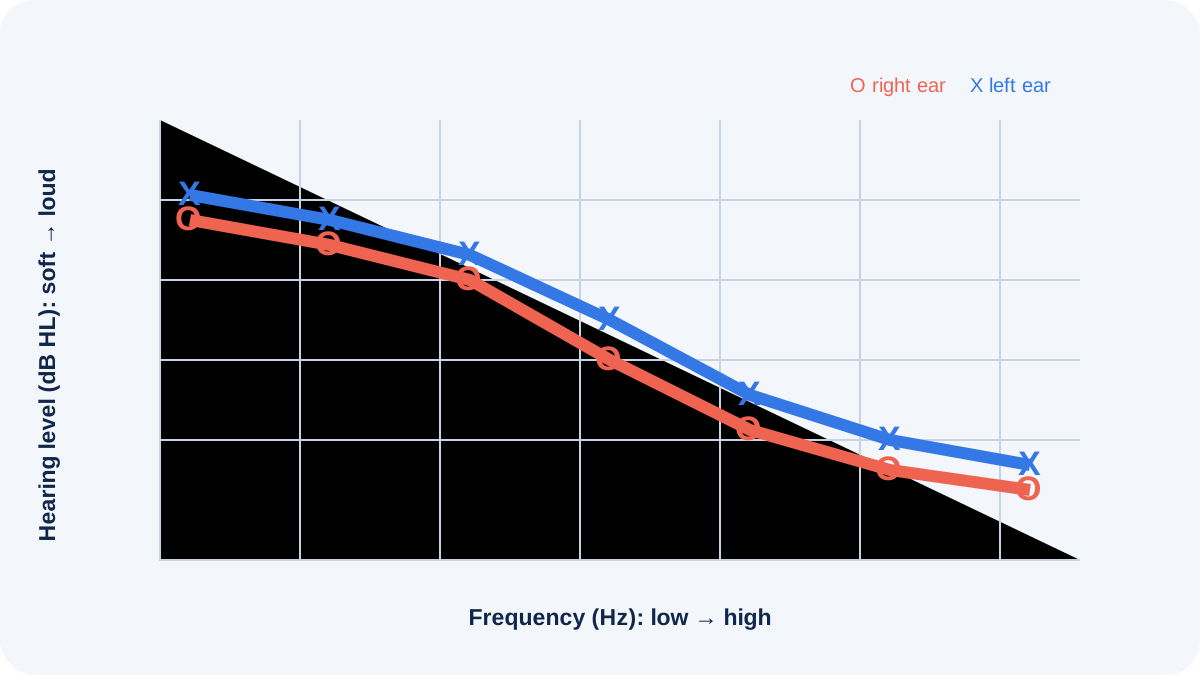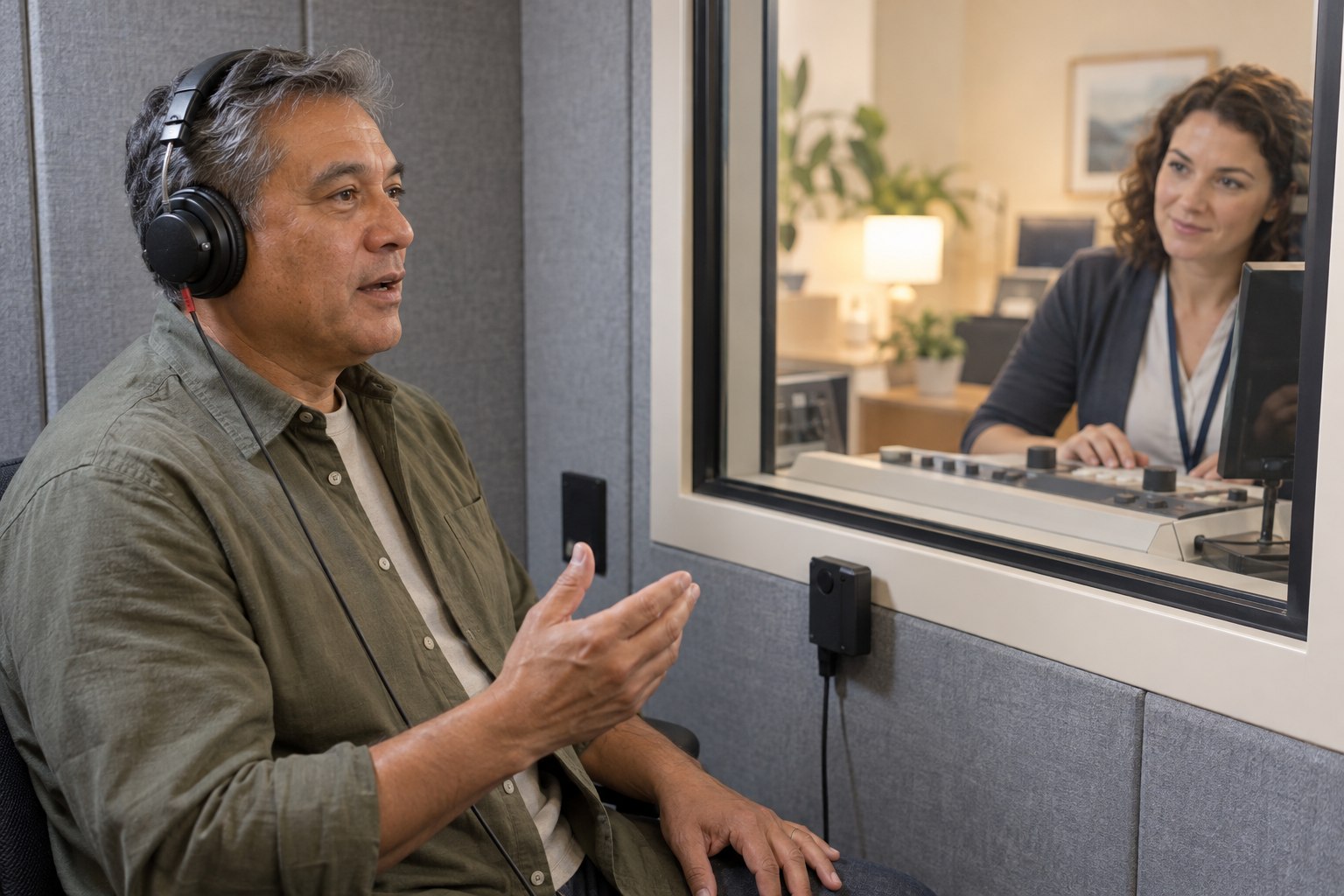
Speech threshold and word recognition answer different questions
A speech recognition or reception threshold estimates the lowest level at which familiar speech material can be identified about half the time. It often provides a cross-check with pure-tone thresholds. A word-recognition test presents a list at a clearly audible level and records how many items are repeated correctly. The second task asks about clarity under that specific condition, not simply audibility.
Clinics may use recorded or monitored live voice material. Recorded lists usually improve consistency. The report should make the method and ear clear.
Presentation level matters
A word list presented too softly may underestimate performance because the items were not fully audible. A very high level can be uncomfortable and, for some patterns, performance may not continue improving. Clinicians select levels using the audiogram, speech threshold, loudness tolerance, equipment limits and the purpose of the test.
Comparing scores from different visits requires more than comparing percentages. The list length, material, presentation level and transducer should be reasonably comparable.
A score has statistical uncertainty
A list samples a limited number of words. Missing one word on a short list changes the percentage more than missing one on a long list. Small differences between scores may fall within expected variability rather than represent a real change. Clinicians can use established critical-difference concepts and the full test pattern when deciding whether a difference matters.
Accent, language familiarity, speech production, attention, cognition and fatigue can also affect the task. A mismatch calls for context, not blame.
Quiet speech is not a noisy meeting
Traditional word recognition is often measured with one talker in quiet. Daily listening may involve competing speech, distance, reverberation and no control over the speaker. A strong quiet score does not rule out substantial difficulty in a restaurant or meeting. Speech-in-noise testing can sample a different problem, but it too represents defined laboratory conditions.
Describe the actual situations that matter and ask whether additional aided or speech-in-noise measures would change recommendations.
A worked comparison
Two people can have similar pure-tone thresholds and different word scores, or similar booth scores and very different workplace demands. One person may need better audibility from a verified hearing-aid fitting; another may need a remote microphone because distance and noise dominate. The speech result helps frame the question but does not select a product by itself.
For implant evaluation, aided speech measures under specified conditions may be particularly important and must follow the center’s current protocol.
Questions to take back
- Was this a speech threshold, word-recognition score or speech-in-noise result?
- What list, level and transducer were used?
- Were ears tested separately and was masking needed?
- Is the difference between ears or visits larger than expected variability?
- Should testing be repeated with verified hearing aids or in noise?
Use the score to improve the next conversation. It cannot diagnose the cause of a hearing change or guarantee benefit from a device.
Language, access and test validity
A test is only useful when the instructions and speech material are appropriate for the listener. Limited familiarity with the language, dialect or vocabulary can reduce a score without showing how the auditory system would perform in the person’s strongest language. Speech production differences may also make spoken repetition a poor response format. Tell the clinician about language history, interpreter needs, literacy, fatigue, cognitive or motor factors and preferred communication before testing begins.
Alternative materials or response methods may improve validity, but scores from different tests should not be treated as interchangeable. Document the adaptation so a later clinic understands what was measured. Caption use, sign language and visual communication are not test failures; they are parts of a person’s access profile.
Use results to design a trial
Translate the finding into a task that can be tested. If quiet word recognition is strong but group conversation remains difficult, define a trial involving noise, distance, turn-taking and a remote microphone rather than increasing hearing-aid volume without a goal. If aided speech access remains limited, verify the hearing-aid fitting before concluding that the underlying technology has reached its limit.
Keep the audiogram and the full speech-test details, not just a percentage written on a sales sheet. At follow-up, ask whether the same list type, ear condition and presentation level were used. Record subjective outcomes too: effort, fatigue, missed names or numbers and participation. Measured performance and lived experience answer different questions, and a responsible plan uses both.
Sources and review notes
Sources were checked for this editorial update on October 12, 2026. External guidance can change; follow the linked source for the current version.
This page provides education, not an individual diagnosis, treatment plan, legal opinion or billing decision. Historical expert contribution is credited only where supported by the original project record; it does not imply review of this update.