
1. The outer ear collects sound
The visible pinna changes and funnels sound toward the ear canal. Its shape also contributes cues that help distinguish whether a sound comes from in front, behind, above or below. The canal ends at the tympanic membrane, commonly called the eardrum.
2. The eardrum and ossicles move
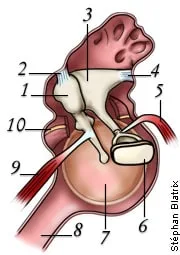
Changing air pressure makes the eardrum vibrate. Three small middle-ear bones—the malleus, incus and stapes—transmit that motion toward the inner ear. This middle-ear system helps transfer energy from air into cochlear fluid. The Eustachian tube helps equalize middle-ear pressure.
3. The cochlea sorts frequency
The stapes moves at the oval window, setting cochlear fluid and membranes in motion. Different regions along the basilar membrane respond most strongly to different frequencies. This organized frequency map is preserved through much of the auditory pathway.
4. Hair cells convert motion to neural activity
Sensory hair cells in the organ of Corti respond to movement between cochlear structures. Inner hair cells are central to converting mechanical movement into signals carried by auditory nerve fibers. Outer hair cells contribute active mechanical amplification and sharp frequency tuning. Damage can reduce sensitivity and clarity; the pattern depends on which cells and frequencies are affected.
5. The auditory nerve carries a coded signal
The cochlear portion of cranial nerve VIII carries activity from the cochlea to the brainstem. It is not an audio cable sending a tiny recording. Timing, frequency and intensity information is represented across patterns of neural firing.
6. The brain builds a useful percept
Signals travel through brainstem and midbrain stations to the thalamus and auditory cortex. Multiple pathways help compare input from the two ears, locate sound, separate competing sources and connect sound with language, attention and memory. Hearing therefore depends on both the ear and the brain.
A practical scenario
A person can detect a voice in quiet yet struggle in a restaurant. The ears may deliver less precise frequency or timing information, and the brain must separate speech from competing sound. Improving the signal-to-noise ratio—through distance, direction, remote microphones or quieter seating—can help even when the audiogram itself has not changed.
Localization and hearing with two ears
The brain compares timing and intensity differences between the ears to help locate sound. The outer ear adds spectral cues, and head movement gives the brain additional information. A difference between ears or reduced access in both ears can make localization and speech separation harder even when a sound remains audible.
This explains why “turning up the volume” is often incomplete. A louder mixture still contains the competing voices and room reflections. Reducing distance, improving microphone placement and keeping visual access to the speaker can improve the signal the brain receives.
Build an evidence record
Sound is collected and transmitted by the outer and middle ear, converted by the cochlea and represented through neural pathways. A problem at different points can produce overlapping complaints, which is why test batteries use several measures.
Write the date, ear or listening condition, equipment or service involved and the decision the evidence is meant to support. Preserve the original report or agreement rather than a cropped screenshot. When two results disagree, record the mismatch and ask what additional check would resolve it. Reliable decisions make uncertainty visible instead of silently converting it into certainty.
Worked decision
A person has a typical tympanogram but reduced high-frequency air and bone thresholds. Middle-ear mechanics appear broadly typical while the threshold pattern points the evaluation toward a sensorineural pathway.
This example shows why the same label can lead to different actions. The recommended next step follows the measured barrier, urgency and complete context. It does not assume that a more expensive device, a louder setting or a single test result is automatically more useful.
Prepare and verify the next step
Use the pathway to ask which structure or function each test samples and which evidence is direct versus inferred. Avoid assuming that a normal result in one subsystem proves the whole pathway is normal.
Choose a repeatable task and define success before the change. Record distance, noise, speaker, program, comfort, handling and any failure. Repeat the task after adjustment and keep a backup communication route while evidence is incomplete or equipment is unavailable.
At follow-up, compare the result with the original goal rather than asking only whether the person “likes it.” Confirm what improved, what remained difficult, whether setup was independent and whether the solution worked for other speakers or rooms. Document maintenance, repair and retesting responsibilities so a successful trial can become dependable daily access.
Share only the information needed for the decision. A clinician may need symptoms and test history, while an employer may need the functional barrier and proposed access method rather than a complete medical record. Clear boundaries protect privacy and keep the discussion focused on the task.
Important boundary
Simplified diagrams teach sequence but cannot represent every feedback connection, central process or individual diagnosis.
Seek prompt professional care for sudden hearing change, severe pain, drainage, acute dizziness, neurologic symptoms or a retained object. Product features, policies and official guidance can change; verify current instructions and primary sources when the decision affects health, safety, money or legal rights.
Sources and review notes
Sources were checked for this editorial update on September 26, 2026. External guidance can change; follow the linked source for the current version.
- NIDCD — How Do We Hear?
- OpenStax — How Acoustic Information Enters the Brain
- Original technical material by Laura Smith-Olinde, PhD
This page provides education, not an individual diagnosis, treatment plan, legal opinion or billing decision. Historical expert contribution is credited only where supported by the original project record; it does not imply review of this update.